
Call us now :07971405443
 Send Inquiry

 Send Inquiry
SECURE - MaxChek 400 Maximum Demand Controller
Price 24999.0 INR/ Piece
MOQ : 1 Piece
SECURE - MaxChek 400 Maximum Demand Controller Specification
- Display Type
- Large, clear digital display with graphical interface
- Multi-level Control
- Multi-level phasewise and shiftwise control for prioritized load disconnection
- Definite & Rolling Demand Periods
- Configurable for rolling or definite demand periods
- Control Relay and Alarm
- Relay outputs and alarm system for actionable notifications
- User Interface
- Large screen with dedicated soft buttons for navigation and programming
- Flexible CT/PT Settings
- Field configurable CT/PT ratios
- Application Area
- Suitable for commercial, industrial, HT consumers, and commercial plant panels
- Contact Outputs
- Four changeover relay alarm outputs (potential free)
- Programming Modes
- Two modes: preventive (alarm only), or preventive and control (alarm and auto-control)
- Automatic Demand Manager
- Built-in automatic demand management to prevent over-consumption
- Ethernet Module (Optional)
- Optional Ethernet for remote monitoring and system integration
- Modbus Support
- Integrated Modbus (RS-485) for communication with other devices
- Real-Time Monitoring
- Displays status of loads that can be added or need to be disconnected
- Automatic Load Management
- Controls and disconnects low priority loads to ensure demand stays within limits
- Software Configuration
- Configurable via user-friendly software
- Predictive Demand Control
- Provides forewarning and initiates control before exceeding limits
- Advance Programming
- Supports advance and flexible programming options
- Demand Panel Support
- Can be used for single or multiple load panel demand configuration
SECURE - MaxChek 400 Maximum Demand Controller Trade Information
- Minimum Order Quantity
- 1 Piece
- Delivery Time
- 7 Days
About SECURE - MaxChek 400 Maximum Demand Controller
Control Your Power Demand. Optimize Your Costs.
Meet Maxchek 400 by Secure a smart maximum demand controller designed to help industries and HT consumers monitor demand, prevent over-demand and manage loads automatically.
Monitor. Control. Optimize.
Contact Indo Overseas Marketing for details: +91-9871157853 / 9871964442
#Maxchek400 #EnergyManagement #PowerManagement #IndustrialAutomation #IndoOverseasMarketing
Proactive Automatic Demand Management
MaxChek 400's built-in automatic demand management system allows users to avoid costly demand peaks by predicting demand surges, triggering alarms, and automatically controlling low-priority loads. This minimizes incidences of over-consumption and helps businesses stay within contracted limits, directly impacting energy cost savings and operational efficiency.
Flexible Control and Integration
With advanced programming options, users can customize demand control by setting preventive alarms or enabling automatic control. Integrated Modbus (RS-485) and optional Ethernet module support seamless connection to energy management systems for remote monitoring, multi-panel use, and enhanced flexibility in commercial and industrial installations.
Intuitive Monitoring and User Interface
A large, graphical digital display and dedicated soft buttons provide clear real-time insights into load status, demand levels, and system alerts. This makes navigation, status checking, and configuration straightforward for users and supports quick decision-making and system responsiveness.
FAQ's of SECURE - MaxChek 400 Maximum Demand Controller:
Q: How does the MaxChek 400 help manage maximum electrical demand?
A: The MaxChek 400 continuously monitors electrical demand and uses predictive algorithms to forecast potential over-consumption. When demand approaches or exceeds preset thresholds, it triggers alarms, disconnects low-priority loads, and provides real-time notifications, thus ensuring your system stays within safe and cost-effective limits.Q: What programming options are available on the MaxChek 400 controller?
A: It supports advance programming with both preventive (alarm-only) and preventive plus control (alarm and auto-control) modes. This flexibility allows users to select whether the device should only notify operators or also take automatic action to disconnect loads as needed.Q: When should I use the Ethernet module with the MaxChek 400?
A: The optional Ethernet module is ideal when remote monitoring, advanced system integration, or centralized control across multiple panels is required. This is especially beneficial for large facilities or plants seeking consolidated energy management.Q: Where can the MaxChek 400 be installed and who should use it?
A: The MaxChek 400 suits a variety of commercial, industrial, and high-tension (HT) consumer environments. It is ideal for commercial plant panels, industries with fluctuating power demand, and any facility needing proactive demand control to prevent penalties or power interruptions.Q: What benefits does predictive demand control offer?
A: Predictive demand control anticipates when electrical demand may exceed limits, providing forewarning and automatically controlling loads before an overage occurs. This early intervention minimizes the risk of penalties from utility providers and supports consistent operational continuity.Q: How do users interact with the controller for monitoring and configuration?
A: Users interact via a large digital display with a graphical interface and soft navigation buttons. Additionally, the system can be configured and monitored using user-friendly software for in-depth parameter adjustment and status tracking.Q: What process does the controller use for load disconnection and prioritization?
A: The MaxChek 400 features multi-level, phasewise, and shiftwise load management. It disconnects or reconnects loads based on priority settings, ensuring that essential equipment remains powered while non-critical loads are managed to maintain operational efficiency during peak demand periods.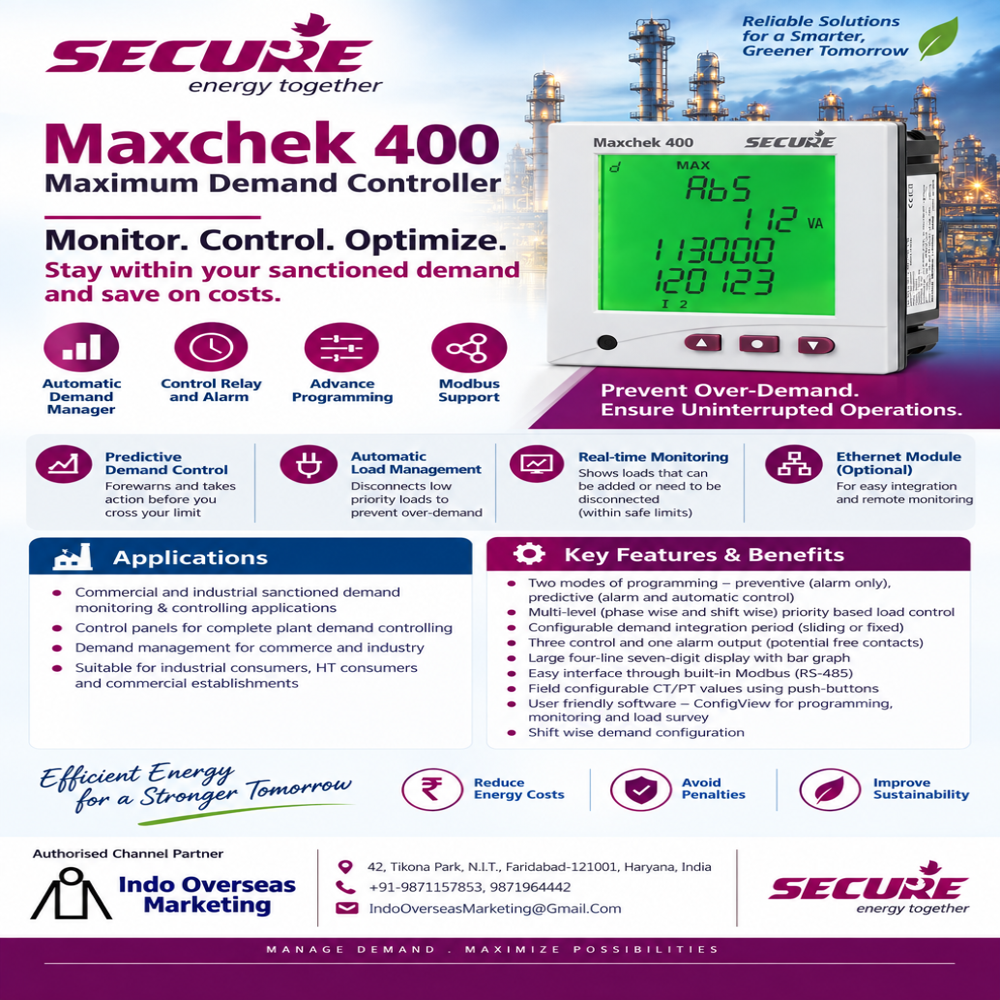
Tell us about your requirement

Price:
Quantity
Select Unit
- 50
- 100
- 200
- 250
- 500
- 1000+
Additional detail
Mobile number
Email

More Products in Digital Panel Meter Category

LED Display Digital Panel Meter
Minimum Order Quantity : 1 Unit
Supply Voltage : 220240 Volt (v)
Display Type : Digital Only
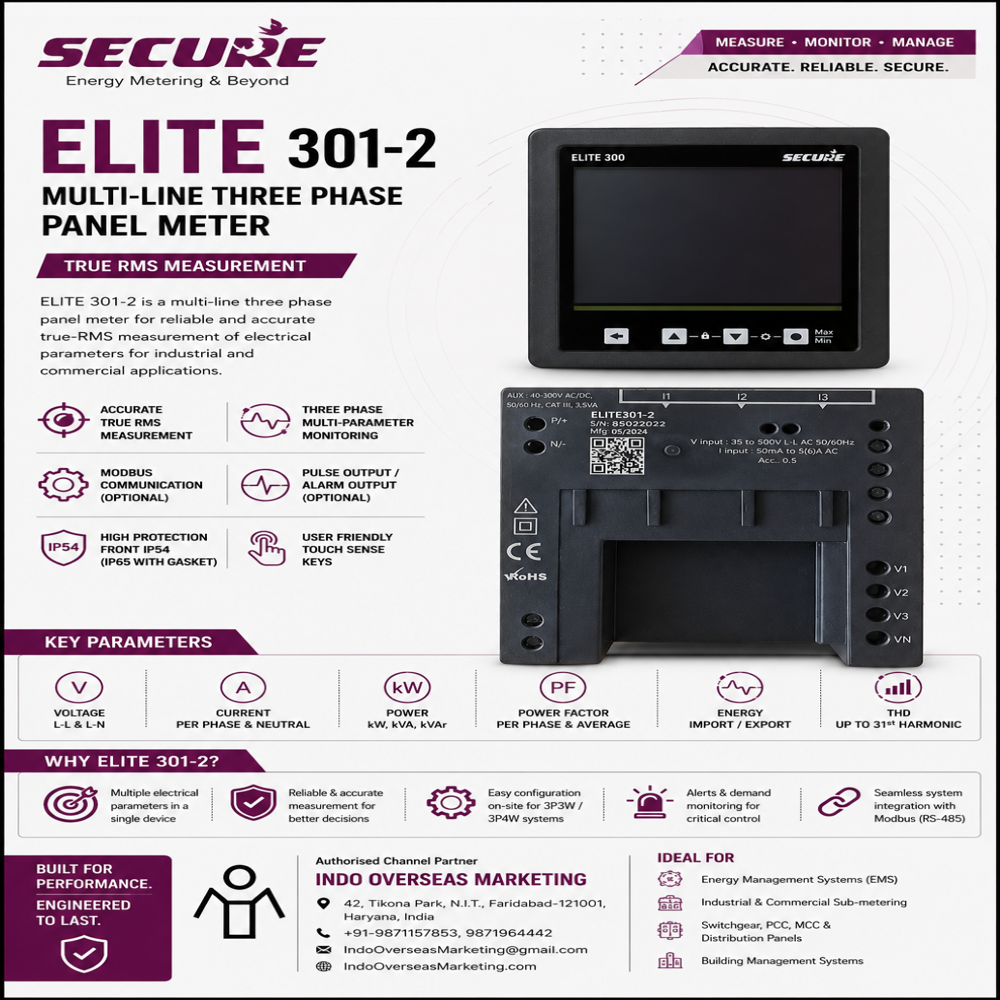
SECURE - ELITE 301 MFM
Price 2549.0 INR / Piece
Minimum Order Quantity : 1 Piece
Supply Voltage : Aux: 40300V AC/DC, 50/60Hz
Display Type : Other, User friendly touch sense keys, large LCD display
Accuracy Class : Class 0.5
Measuring Voltage Range : 35 500V LL AC (Up to 600V AC with Auxiliary supply)

SECURE - ELITE 440 MFM
Price 4999.0 INR / Number
Minimum Order Quantity : 1 Number
Supply Voltage : Auxiliary power required (value not specified in image)
Display Type : Other, Large multiline, sevendigit backlit LCD display
Accuracy Class : Class 0.2 / 0.5s / 1.0
Measuring Voltage Range : Suitable for both LV & MV panels

SECURE - DPM96V200-2
Price 999.0 INR / Number
Minimum Order Quantity : 1 Number
Supply Voltage : 80300 V AC/DC
Display Type : Other, LED Digital Display
Accuracy Class : Class 1.0
Measuring Voltage Range : 0500 V AC

 Send Inquiry
Our Products
- Control Panel
- DOL Starter Panel
- Monoblock Pump
- Submersible Pump
- Electricity Meter
- MCB Switch
- Self Standing Enclosure
- Energy Meter
- Copper Wire
- Electric Motor
- Multistage Pressure Pump
- Electrical Contactor
- Submersible Flat Connection Cable
- Electrical Enclosure
- Terminal Box
- MCCB Board
- Networking Rack
- Changeover Switch
- Pressure Booster Pumpset
- Digital Panel Meter
- Distribution Board
- Circuit Breaker
- Electric Plug And Socket Box
- Centrifugal Water Pump
- Electric Relay
- Electric Switch
- Limit Switch
- Surge Protection Devices
- Power Factor Controller


No-42, Tikona Park, NIT,Faridabad - 121001, Haryana, India

Mr. Lalit Sharma
(Owner)
Mobile :07971405443
 Send Inquiry

Developed and Managed by Infocom Network Private Limited.
